The Bible’s Family-Imagery of
The Bridegroom, The Bride, and Israel
By Larry N. Baker
Among the relationships within the Trinity, the imagery of the relationship of Father and Son is most pervasive through scripture. For all eternity God, as Father, has communicated with and loved God, as Son. The eternal Sonship of Jesus Christ in His deity is a hallmark in a biblical understanding of the Trinity. One facet of this triune relationship is found from the vantage-point of the Church. The Church stands in a matrimonial covenant with Jesus Christ. Paul elaborated upon this family and bridal imagery, where he speaks of himself in a sense, as a paranymph, in 2 Corinthians 11:2, “For I am jealous for you with God’s jealousy. For I betrothed you to one husband, as a chaste virgin to present you to Christ.” John described the fulfillment of this bridal covenant at a marriage supper in Revelation 19:17, “Let us be glad and rejoice and give Him glory, for the marriage of the Lamb has come, and His wife has made herself ready.” Then he continued with this bridal picture of the Church through to the end of his Revelation in Revelation 21:2, 9; 22:17.
From Genesis through Revelation God has paralleled His Covenant of Salvation with His Covenant of Matrimony, beginning with Adam and Eve in Genesis 2 through Revelation 22 where “the Spirit and the Bride say, ‘Come.’” Two keys that both of these covenants have in common are the foci on relationship and commitment. Marriage becomes God’s primary way to picture salvation in this life and the life to come. Thus, beyond this life the covenant of marriage become unnecessary. Resurrected believers will be “like the angels” and not within any covenant of marriage, as Jesus explained in. Matthew 22:30, “For in the resurrection they neither marry nor are given in marriage, but as the angels of God in heaven.”
In a rather interesting parallel of imagery found within the Old Testament, Israel also has a covenant relationship with Jehovah God by the love of a betrothal, as Jeremiah reminded straying Israel in Jeremiah 2:2, “Go and call in the hearing of Jerusalem, saying, ‘Thus says the LORD, “I remember you, the kindness of your youth, the love in your betrothal, walking after me in the desert, in a land not sown.”’” God is recalling Israel’s young tenderness with the love of being a young bride, when she followed him in the barren desert of Sinai and later explains how he was “as a husband to them” in Jeremiah 31:31-32, “‘Behold, the days are coming,’ says the LORD, ‘when I will make a new covenant with the house of Israel and with the house of Judah, not according to the covenant which I made with their fathers in the day of my strengthening them by their hand to go from the land of Egypt, where they themselves broke my covenant, though I was a husband for them,’ says the LORD.’”[1] Thus, Israel is seen as the Betrothed of God the Father. As God spoke of the reason for His concern about Israel’s backsliding into sin earlier in Jeremiah 3:14,[2] He specifically stated, “for I am married to you.” In an earlier day Isaiah had taught Israel how God the Father “your Maker is your Husband” in Isaiah 54:5, and described Israel in calling her land “Beulah” meaning “married woman” – in Isaiah 62:4, “You shall no longer be termed Forsaken, Nor shall your land any more be termed Desolate; but you shall be called Hephzibah, and your land Beulah; For the LORD delights in you, And your land shall be married.”[3] Thus, in a certain way with this “Beulah” of God the Father one could call Israel and her land “Mrs. Jehovah.” Solomon described in Proverbs 2:16-17 the seductive woman who forgot about her marriage, but in his description he wrote, “who forsakes the confidant of her youth and forgets the covenant of her God.” A married person’s marriage covenant is actually the covenant of one’s God.
Jeremiah described this imagery of marriage between God and Israel in Jeremiah 3:14 - “Return, O backsliding children,” says the Lord; “for I am married to you. I will take you, one from a city and two from a family, and I will bring you to Zion.” NKJV But then he spoke of Israel’s “adultery” in Jeremiah 3:8 – “Then I saw that for all the causes for which backsliding Israel had committed adultery, I had put her away and given her a certificate of divorce; yet her treacherous sister Judah did not fear, but went and played the harlot also.” NKJV However, because of the uniqueness of God’s marriage to Israel, no paganism would be considered such a marriage-covenant, thus in light of Deuteronomy 24:1-4, Jeremiah explained how Israel can return to her Husband in Jeremiah 3:1 - “They say, ‘If a man divorces his wife, and she goes from him and becomes another man’s, may he return to her again?’ Would not that land be greatly polluted? But you have played the harlot with many lovers; yet return to Me,” says the Lord.
Isaiah had earlier described this estrangement of Israel from God with “the certificate of your mother’s divorce” in Isaiah 50:1. This chapter begins a four-chapter prophesy about Jesus Christ, God the Son, who is introduced earlier in Isaiah 48:16, “Come near Me, hear this: I have not spoken in secret from the beginning; from the time that it was, I was there. And now the LORD God [as the Father] and His Spirit [as God the Holy Spirit] has sent Me [as God the Son].” Israel is the mother of Jesus Christ, Yeshua the Messiah.[4]
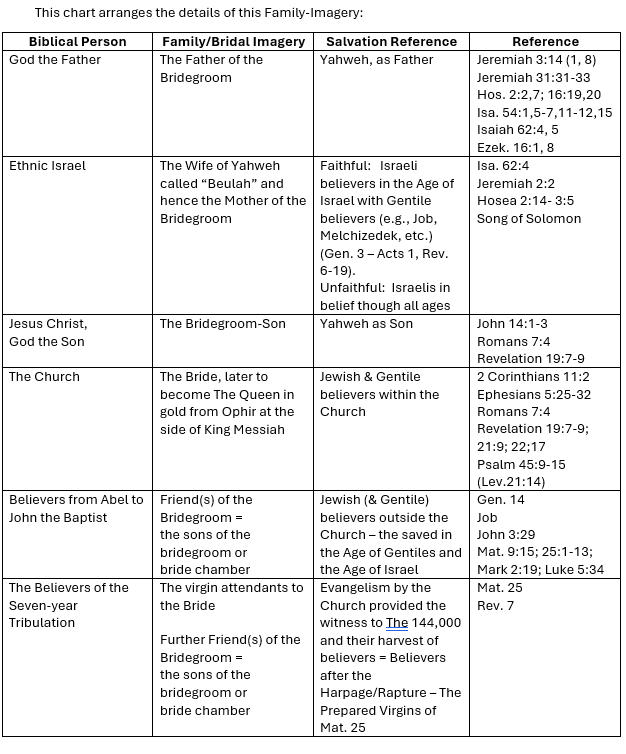
Thus, to frame this family imagery in “a family tree” one has God the Son described, as an honorable Bridegroom. The Church is His chaste, betrothed Bride made of Jewish and Gentile believers from Pentecost in Acts 2 through Revelation 3. God the Father is the Father of this Bridegroom and hence within this imagery would be viewed, as the “Church’s Father-in-law.” But in a point of a contrast, there have been Jewish unbelievers of today and through the ages, who have had no faith nor interest in Jesus, as their Messiah. They can be thus pictured, as the unfaithful spouse in their land called “Beulah,” just as unfaithful Gomer was to Hosea[5] who described this in his first three chapters. In their estrangement from Jesus, their Messiah, Jewish unbelievers’ infidelity to Jehovah God continues even to this day. Paul described this in 2 Corinthians 3:13-16, “Unlike Moses who was putting a veil upon his own face, for the sons of Israel not to gaze at the end of what was transitory, but their thinking was hardened; for until today the same veil remains unlifted during the reading of the Old Testament, because in Christ it [i.e., the veil] is removed, but until today, whenever Moses is read, a veil lies on their hearts. But whenever one does turn toward the Lord, the veil is lifted.” Messianic believers in Jesus, whom they lovingly call Yeshua, find in their salvation a new understanding of the Bible. These Jewish believers are thus a part of the Bride of Christ, the Church.
However, the actions of those unbelievers of ethnic Israel who reject God’s covenant and eternal salvation have been described in their idolatry[6], as “harlotry” in Deuteronomy 31:16; Judges 2:17; Psalm 73:27; Hosea 4:12 and 9:1. Throughout the centuries, since the first century, many faithless in Israel have substituted the Jehovah[7] God of Abraham, Isaac, Jacob, and Yeshua (their Hebrew form for Jesus) with their alternate view of a Jehovah in Judaism devoid of Yeshua. Their deity is, as they call Him, Jehovah. But even though such a deity may be close to that of Yeshua’s Jehovah, it is not the same.[8]
The essence of idolatry is simply taking a different understanding of God than that found in the Bible. This is most colorfully illustrated by Gomer with her husband, Hosea, in Hosea 2-3, which Hosea thus applies in detail to Israel in Hosea 4-14. Even today, faithless Israelis have continued to reject Jesus (Yeshua), as their Messiah (Mashiach). They have lived in an “idolatrous” form of Judaism or even simple secularism. But this imagery may have a more interesting parallel in the last days before Christ’s millennial kingdom. The prophecy illustrating Israel with Gomer in Hosea 2:14 through 3:5[9] is most interesting here. There will come a time in the future, when God will restore future Israelis to a place of ministry for His kingdom, as Hosea[10] restored Gomer. God has continued to keep ethnic Israel in safety…in reserve…through the centuries, throughout the time of the present Church Age beginning in Acts 2…to restore her for a time of faithfulness during a future seven-year Tribulation. Jesus spoke of this in Matthew 24:29, “Immediately after the tribulation of those days the sun will be darkened, and the moon will not give its light; the stars will fall from heaven, and the powers of the heavens will be shaken.” This will be fulfilled in Christ’s Second Coming back to earth at end of this seven-year period with the Battle of Armageddon. This future period is outside of God’s plan for Jesus’ Bride, the Church. There will be believers both through the ages up to Acts 2 and during this future seven-year period. In a popular dispensational perspective these Jewish and Gentile believers outside the Church can be seen within this imagery, as “the Friends of the Bridegroom.”
John the Baptist mentioned this idea of “the friend of the bridegroom” that appears to be a reference to himself in John 3:29.[11] John the Baptist was the last prophet of the Age of Israel (which is described in Genesis 12 through Acts 1), before the Church Age began in Acts 2. Jesus also described believers finding eternal salvation during the time before the Church Age, as “the sons [i.e., friends] of the Bridegroom”[12]in Matthew 9:15.[13] So thus one finds a fifth party in this Bridal imagery, “the best man” – so to speak – those believers through the ages who are not a part of the Church.[14] This is often misunderstood, when some seek to place all believers through the ages within the Church. But then various passages in the Bible (such as Matthew 19:28 and Luke 19:17, 19) have those within the Church in a special place of responsibility over other believers later in the Kingdom Age yet to come.
So this Family Tree falls into place, where we have God the Father in matrimonial covenant with ethnic Israel betrothed at Mount Sinai. This faithless wife begat a son, Yeshua HaMashiah – Jesus Christ. John wrote a general and colorful apocalyptic description of this in Revelation 12:1-6.[15] So, thus we have –
The Family Tree: God the Father + Israel (Mrs. Jehovah)
|
God the Son + The Church
The Bridegroom The Bride
King of Kings Queen Consort
Even though the Church within its Church Age is not revealed in the Old Testament, there is an interesting hint of her (we Christians) with The Messianic King in Psalm 45. He has a Queen! She is only described here. His Queen described specifically in verses 9 through 15: “Kings’ daughters are among Your honorable women; at Your right hand stands the queen in gold from Ophir” (verse 9). The term for “Queen” here is Shegal rather than Malchah that is the common word for queen (as the feminine of Melech, king in Hebrew). Shegal refers to a “queen-consort” rather than a “queen co-regent” (as does Malchah). This Hebrew word is also used in Nehemiah 2:6 for King Artaxerxes’s queen consort. This Queen[16] would well be the Church during the future Millennial Kingdom Age of Christ. Note the rest of her description in Psalm 45:10-15 –
Listen, O daughter, Consider and incline your ear;
Forget your own people also, and your father’s house;
So the King will greatly desire your beauty;
Because He is your Lord, worship Him.
And the daughter of Tyre will come with a gift;
The rich among the people will seek your favor.
The royal daughter is all glorious within the palace;
Her clothing is woven with gold.
She shall be brought to the King in robes of many colors;
The virgins, her companions who follow her, shall be brought to You.
With gladness and rejoicing they shall be brought;
They shall enter the King’s palace.
[1] In Hebrews 8:9 this verse has an interesting interpretation of the Masoretic Text of the Tanach: “‘…not according to the covenant which I made with their fathers in the day which I took their hand to guide them out of the land of Egypt, because they themselves did not continue in my covenant, I myself even was unconcerned about them,’ says the Lord.” This “was-unconcerned,” amelein (avmele,in - not to care; show no interest in, pay no attention to, ignore, disregard ), can be an interpretation of what Hosea, as a husband, had to do with Gomer in Hosea 2:2-5, 9-13, 23; 3:4, as the parallel is developed through Hosea 4-5, 8-10, 13.
[2] Jeremiah 3:14 - “Return, O backsliding children,” says the LORD; “for I am married to you. I will take you, one from a city and two from a family, and I will bring you to Zion.”
[3] Literally – “You will no longer be said to be Azubah [Deserted], and your land will no longer be said to be Shmamah [Desolate], because you will be called Chephtsi-bah [My-Delight-is-in-her], and your land Beulah [Married], because Jehovah will be delighted in you, and your land will be called Tibael [She-will-be-Married]”
[4] This is what John was describing in Revelation 12:1-5.
[5] It is interesting to note that the name Hosea (in Hebrew Hoshea’) is related to the names Joshua and Jesus. Joshua in Hebrew is Yehoshua’ which is Yah (Jehovah) attached to Hoshea’ and was latter shortened to Yeshua’ which became Iēsous in Greek and then Iesus in Latin and then Jesus in English.
[6] Note that the essence of idolatry is not statuary but simply replacing a biblical view of God with an unbiblical view of God.
[7] This English form of God’s holy name (coming from YHWH in Hebrew) is often translated LORD in conventional English translations, such as the King James Version and New King James Version.
[8]Yeshua observed this about one of the Jewish scribes in Mark 12:28-34, where he remarked in verse 34, “You are not far from the kingdom of God.”
[9] Hosea 2:14-3:5 – 14 “Therefore, behold, I will allure her, will bring her into the wilderness, and speak comfort to her. 15 I will give her vineyards from there, and the Valley of Achor as a door of hope; she shall sing there, as in the days of her youth, as in the day when she came up from the land of Egypt. 16 And it shall be, in that day,” Says the LORD, “That you will call Me ‘My Husband,’ and no longer call Me ‘My Master,’ 17 for I will take from her mouth the names of the Baals, and they shall be remembered by their name no more. 18 In that day I will make a covenant for them with the beasts of the field, with the birds of the air, and with the creeping things of the ground. Bow and sword of battle I will shatter from the earth, to make them lie down safely. 19 I will betroth you to Me forever; Yes, I will betroth you to Me in righteousness and justice, in lovingkindness and mercy; 20 I will betroth you to Me in faithfulness, and you shall know the LORD. 21 It shall come to pass in that day That I will answer,” says the LORD; “I will answer the heavens, And they shall answer the earth. 22 The earth shall answer with grain, with new wine, and with oil; they shall answer Jezreel. 23 Then I will sow her for Myself in the earth, And I will have mercy on her who had not obtained mercy; then I will say to those who were not My people, ‘You are My people!’ And they shall say, ‘You are my God!’ 3:1 Then the LORD said to me, “Go again, love a woman who is loved by a lover and is committing adultery, just like the love of the LORD for the children of Israel, who look to other gods and love the raisin cakes of the pagans.” 2 So I bought her for myself for fifteen shekels of silver, and one and one-half homers of barley. 3 And I said to her, “You shall stay with me many days; you shall not play the harlot, nor shall you have a man -- so, too, will I be toward you.” 4 For the children of Israel shall abide many days without king or prince, without sacrifice or sacred pillar, without ephod or teraphim. 5 Afterward the children of Israel shall return and seek the LORD their God and David their king. They shall fear the LORD and His goodness in the latter days.” NKJV
[10] Ezekiel 16 has an interesting parallel summarizing this.
[11] John 3:29 – “He who has the bride is the bridegroom; but the friend of the bridegroom, who stands and hears him, rejoices greatly because of the bridegroom’s voice. Therefore this joy of mine is fulfilled.” NKJV
[12] Literally, “the sons of the bridal chamber.”
[13] “And Jesus said to them, ‘The sons of the bridegroom are not able to mourn, as long as the bridegroom is with them, are they? But days are coming, when the bridegroom might be taken away from them, and then they will fast.’”
[14] There is a rather odd but interesting case of some twelve disciples of John the Baptist in Acts 19:1-7 who were a part of these “friends of the Bridegroom” in the Age of Israel and became a part of the Bride, Church.
[15] Revelation 12:1-6, “Now a great sign appeared in heaven: a woman clothed with the sun, with the moon under her feet, and on her head a garland of twelve stars. Then being with child, she cried out in labor and in pain to give birth. And another sign appeared in heaven: behold, a great, fiery red dragon having seven heads and ten horns, and seven diadems on his heads. His tail drew a third of the stars of heaven and threw them to the earth. And the dragon stood before the woman who was ready to give birth, to devour her Child as soon as it was born. She bore a male Child who was to rule all nations with a rod of iron. And her Child was caught up to God and His throne. Then the woman fled into the wilderness, where she has a place prepared by God, that they should feed her there one thousand two hundred and sixty days. “
[16] Jesus apparently was referring to this rule of the Queen consort with Israel subordinate in Matthew 19:28, “But Jesus said to them, ‘Truly I say to you that you who follow Me in the Regeneration, when the Son of man might sit upon the throne of his glory, you yourselves also will sit upon the twelve thrones, judging the twelve tribes of Israel.’” This may also be the fulfillment of Jesus’ words in Luke 19:17 concerning believers in the Church ruling over five or ten cities.